Injection Mold Industry: Precision and Green Development Drive Manufacturing Upgrade

Known as the "Mother of Manufacturing", injection molds serve as the core equipment for plastic product molding, and are widely applied in numerous sectors such as automotive, electronics, home appliances, and medical devices. In recent years, with the rapid rise of emerging industries like new energy vehicles and smart terminals, coupled with the comprehensive popularization of the green manufacturing concept, China's injection mold industry is moving away from the traditional extensive development model and stepping into a new stage of high-quality development centered on precision, intelligence, and green sustainability, emerging as a crucial driving force supporting the transformation and upgrading of the manufacturing sector.
In terms of industry scale, China has become the world's major producer and consumer of injection molds. According to data released by the China Die & Mould Industry Association, the market size of China's mold industry exceeded 480 billion yuan in 2024, among which injection molds accounted for over 55%, reaching a market size of 264 billion yuan and ranking first globally for consecutive years. Leveraging the advantages of a well-established manufacturing industrial chain, the Yangtze River Delta and Pearl River Delta regions have evolved into core clusters for the injection mold industry, gathering more than 60% of the country's above-scale mold enterprises and forming a complete industrial ecosystem covering mold design, material supply, processing and manufacturing, and after-sales service.
Breakthroughs in precision technology have become the key to enhancing the industry's competitiveness. Traditional injection molds generally feature a precision level of 0.05mm, which struggles to meet the demands of high-end manufacturing. Today, with the popularization of advanced equipment such as five-axis machining centers and high-speed milling machines, as well as the widespread application of integrated CAD/CAM/CAE design technologies, the precision of China's injection molds has achieved leapfrog progress. Some high-end products now boast a precision level of 0.01mm, which can accurately meet the molding requirements of high-end products including microelectronic components and precision medical devices. In the new energy vehicle sector, injection molds used for battery casings and interior parts must not only satisfy complex structural design requirements but also ensure consistency in mass production. Thanks to breakthroughs in precision technology, the localization rate of injection molds for automotive use in China has risen to over 85%, effectively reducing reliance on imported molds.
Green transformation has become an inevitable trend for the industry's development. Guided by the "dual carbon" goals, the injection mold industry is promoting green transformation across the entire process, from material selection and production processing to waste disposal. In terms of materials, the R&D and application of biodegradable plastic molds and molds dedicated to recycled plastics are continuously deepened, reducing the use of non-degradable materials. In the production phase, the penetration rate of energy-efficient injection mold equipment has exceeded 45%. By optimizing mold structural design to lower clamping force requirements, the energy consumption of a single mold during production has decreased by 20%-30% compared with traditional equipment. In the field of waste disposal, the industry has generally implemented a recycling and reuse system for mold production waste. At present, the plastic waste recycling rate has exceeded 90%, and some enterprises have achieved closed-loop recycling of production waste, significantly reducing resource waste and environmental pressure.
Intelligent upgrading is accelerating the improvement of industrial efficiency. The integration of industrial internet and internet of things technologies with the injection mold industry is deepening, and intelligent molds have emerged as a new hotspot in the industry's development. Smart injection molds equipped with real-time monitoring, data collection, and automatic adjustment functions have been put into application in mass production. By embedding sensors inside the molds, key parameters such as temperature and pressure during the molding process can be monitored in real time. Once deviations occur, the system can automatically adjust process parameters, effectively improving product qualification rates. Meanwhile, the application of 3D printing technology in mold manufacturing is gradually becoming widespread. Using 3D printing rapid prototyping technology to produce mold cavities and cores can shorten the mold development cycle by 30%-50% and significantly reduce the production costs of small-batch and customized molds.
Looking ahead, as the demand for injection molds from emerging industries continues to upgrade, the industry will face higher technological challenges and development opportunities. On one hand, the localization of high-end equipment and the independent controllability of core materials will become the focus of the industry's technological research. On the other hand, the level of green sustainability and intelligence will be further enhanced, driving the injection mold industry towards a more efficient, environmentally friendly, and precise direction. As a key link in the manufacturing industrial chain, the high-quality development of the injection mold industry will provide solid support for China's transformation from a major manufacturing country to a manufacturing power.

The Ten Most Common Injection Molding Materials

In the world of precision injection molding, materials are the soul of products. Behind a 0.1-gram micro gear and a 10-kilogram automotive structural component lies the precise game of materials science. As a 15-year-experienced expert in plastic mold intelligent manufacturing rooted inYRD, we analyze the characteristics of the top 10 most widely used injection molding materials globally:

  1. 1/ PP (Polypropylene)Key Properties: Density 0.9g/cm³ | Melting Point 160℃ | Food-grade CertifiedProcess Breakthrough: 0.3mm ultra-thin wall high-speed injection molding (±0.05mm precision)Typical Applications: Food packaging containers (e.g., crisper boxes), medical device housings (e.g., syringes)

  2. 2/ ABS (Acrylonitrile Butadiene Styrene) Engineering PlasticKey Properties: Impact Strength 25kJ/m² | Heat Deflection Temperature 98℃Process Breakthrough: Nano mirror polishing technology (surface roughness Ra≤0.05μm)Typical Applications: Consumer electronics housings (e.g., mobile phone casings), automotive interior parts (e.g., instrument panels)

  3. 3/ PC (Polycarbonate)Key Properties: Light Transmittance 90% | Notched Impact Strength 65kJ/m²Process Breakthrough: Vacuum degassing technology (99.2% yield rate for optical components)Typical Applications: Optical lenses (e.g., VR glasses), safety protective equipment (e.g., helmet visors)

  4. 4/ PE (Polyethylene)

    Key Properties: Tensile Strength 25MPa | Low Temperature Resistance -50℃

    Process Breakthrough: One-piece molding of 30L storage tanks (wall thickness tolerance ±0.8mm)

    Typical Applications: Daily necessities packaging (e.g., shampoo bottles), industrial storage tanks (e.g., chemical containers)

  5. 5/ POM (Polyoxymethylene)

    Key Properties: Coefficient of Friction 0.2 | Dimensional Shrinkage Rate 2.1%

    Process Breakthrough: Gradient cooling crystallization technology

    Typical Applications: Precision gears (e.g., automotive gearboxes), bearings (e.g., transmission parts for household appliances)


  6. 6/ TPU (Thermoplastic Polyurethane)

    Key Properties: Shore Hardness 85A | Biocompatibility Compliant with ISO 10993

    Process Breakthrough: Microcellular foaming for 40% weight reduction (cell diameter ≤50μm)

    Typical Applications: Medical catheters (e.g., infusion tubes), sports equipment (e.g., shoe soles)

  7. 7/ PA66 (Nylon 66)

    Key Properties: Flexural Strength 110MPa | Flame Retardant Rating UL94 V-0

    Process Breakthrough: Integrated glass fiber reinforcement + LDS laser direct structuring

    Typical Applications: 5G communication housings (e.g., base station enclosures), automotive functional components (e.g., engine covers)

  8. 8/ PMMA (Polymethyl Methacrylate / Acrylic)

    Key Properties: Light Transmittance 92% | Pencil Hardness 6H

    Process Breakthrough: Ion implantation hardening technology

    Typical Applications: Optical light guide plates (e.g., LED panels), medical devices (e.g., endoscope barrels)

  9. 9/ PS (Polystyrene)

    Key Properties: Glossiness 95% | Melt Flow Index 12g/10min

    Process Breakthrough: Molecular orientation control technology

    Typical Applications: Instrument windows (e.g., household appliance display screens), disposable products (e.g., tableware)

  10. 10/ Bio-based PLA (Polylactic Acid)

    Key Properties: Degradation Rate 90% in 6 Months | Tensile Strength 45MPa

    Process Breakthrough: Straw fiber reinforced formulation

    Typical Applications: Eco-friendly packaging (e.g., biodegradable lunch boxes), baby products (e.g., toy components)

The manufacturing PMI rose to 49.2% in November, with the sector's exports stabilizing

The new export order indices for the four major manufacturing sectors as well as large, medium, and small enterprises all rose month-on-month.
As steady growth policies continue to take effect and positive outcomes were achieved in the China-U.S. economic and trade talks at the end of October, the National Bureau of Statistics (NBS) announced on November 30 that China's Manufacturing Purchasing Managers' Index (PMI) for November stood at 49.2%, up 0.2 percentage points from the previous month.
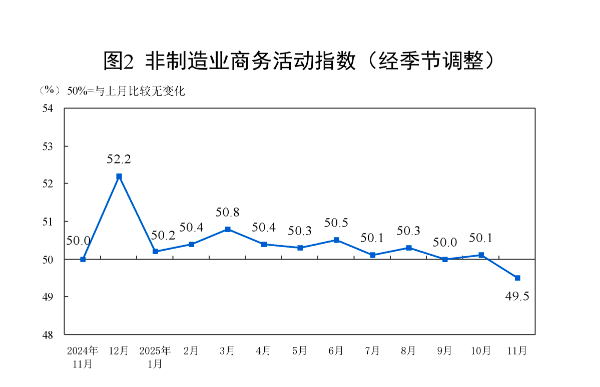
Affected by the high base effect of the Golden Week holiday last month, consumer-related service sector activities showed a seasonal decline. In November, the Non-Manufacturing Business Activity Index was 49.5%, down 0.6 percentage points month-on-month. The Composite PMI Output Index was 49.7%, a decrease of 0.3 percentage points from the previous month.

Zhang Liqun, a special analyst at the China Federation of Logistics and Purchasing (CFLP), noted that the slight recovery of the manufacturing PMI in November indicates improved market confidence. "The inspiring development goals of the 15th Five-Year Plan have had a positive impact on market sentiment. However, it is noteworthy that the manufacturing PMI remains below the boom-bust line, with demand contraction driven by market factors still prominent and the economy facing downward pressure."

Zhang emphasized the need to further strengthen counter-cyclical adjustments of macroeconomic policies around the sound start of the 15th Five-Year Plan, significantly expand government investment in public goods and services, effectively drive growth in corporate orders, and quickly reverse the trend of market-driven demand contraction.

Manufacturing: Stabilizing with Upside Momentum

Despite the complex international economic environment, the consensus reached on key outcomes in China-U.S. economic and trade consultations improved China's foreign trade environment in November, with manufacturing exports stabilizing. The New Export Order Index rose 1.7 percentage points month-on-month to 47.6%, a notable increase. Stabilized exports drove a partial recovery in overall manufacturing market demand, with the New Order Index climbing 0.4 percentage points to 49.2%.
Wen Tao, an expert at the China Logistics Information Center, stated that November's manufacturing export stabilization was comprehensive: new export order indices for the four major manufacturing sectors and all enterprise sizes (large, medium, small) rose month-on-month. Specifically, the index for high-tech manufacturing surged over 3 percentage points, consumer goods manufacturing increased by more than 2 percentage points, and both large and small enterprises saw gains exceeding 2 percentage points.
Recovering demand boosted enterprises' production willingness, keeping manufacturing activities stable. The Production Index returned to the boom-bust line at 50% in November, up 0.3 percentage points from the previous month's temporary contraction.
By sector, the Production Index for equipment manufacturing, high-tech manufacturing, and consumer goods manufacturing remained in expansion territory. The index for basic raw materials manufacturing rose month-on-month, indicating steady growth in new drivers and consumer goods production, as well as a stable recovery in basic raw materials output—reflecting a coordinated and stable operation of manufacturing production.
Amid stable overall manufacturing activities, finished goods de-stocking accelerated. The Finished Goods Inventory Index dropped 0.8 percentage points to 47.3%, declining for two consecutive months, which signals smooth corporate sales.
On the price front, synchronized stabilization of supply and demand strengthened market price support. Manufacturing raw material prices rose faster, with the Purchasing Price Index increasing 1.1 percentage points to 53.6%. Driven by higher raw material costs and stabilized demand, the decline in finished goods prices narrowed: the Producer Price Index rose 0.7 percentage points to 48.2%.

Looking ahead to the manufacturing PMI trend, Wen Tao predicted that in December, all sectors will enter the year-end sprint phase, coinciding with a critical period for policy implementation and fund disbursement. Coupled with expected demand growth from the launch of the 15th Five-Year Plan and normalized import-export activities amid stabilized foreign trade, manufacturing market demand is poised for further stabilization and recovery, driving steady growth in production. Raw material prices may continue to rise steadily, while finished goods prices will tend to stabilize.

Non-Manufacturing: Seasonal Decline

In November, the Non-Manufacturing Business Activity Index fell 0.6 percentage points month-on-month to 49.5%, indicating a slight weakening in non-manufacturing sentiment.
Affected by the fading holiday effect, the Services Business Activity Index dropped 0.7 percentage points to 49.5%. By sector, industries such as railway transportation, telecommunications, radio, television and satellite transmission services, and monetary and financial services maintained a high boom level above 55.0%, with rapid business volume growth. In contrast, real estate and residential services remained below the boom-bust line, reflecting weak market activity.
He Hui, Vice President of the CFLP, attributed the non-manufacturing slowdown mainly to the seasonal decline in consumer-related services due to the high base effect of last month's Golden Week. Business Activity Indices for sectors including retail, accommodation and catering, transportation, tourism, culture, sports, and entertainment all fell to varying degrees. He noted that concentrated demand from year-end festivals and winter consumption is expected to drive a recovery in consumer-related services.
The Construction Business Activity Index improved slightly by 0.5 percentage points to 49.6% in November. The Business Activity Expectations Index rose 1.9 percentage points to 57.9%, indicating increased confidence among construction enterprises in near-term industry development.
Wu Wei, an expert at the China Logistics Information Center, projected that accelerated progress on key year-end projects will generate substantial physical workloads. Combined with the synergistic effect of special bonds and policy-based financial instruments, investment is expected to remain resilient at year-end, underpinning steady growth.
Wu summarized that while non-manufacturing activities slowed due to the seasonal decline in consumer-related services, positive factors are emerging—including robust financial activities, sound development of new drivers, and a recovery in construction. As the year-end approaches, sustained policy support and the year-end sprint in supply and demand are expected to release investment and consumption potential, laying the foundation for a strong annual economic finish. However, he emphasized that sustained stable economic operation requires accelerated implementation of various policies to boost social expectations and fully unlock demand potential.


0599-5202613